Google June 2026 EU Financial Services Verification Expansion: 30-Day Compliance Deadline
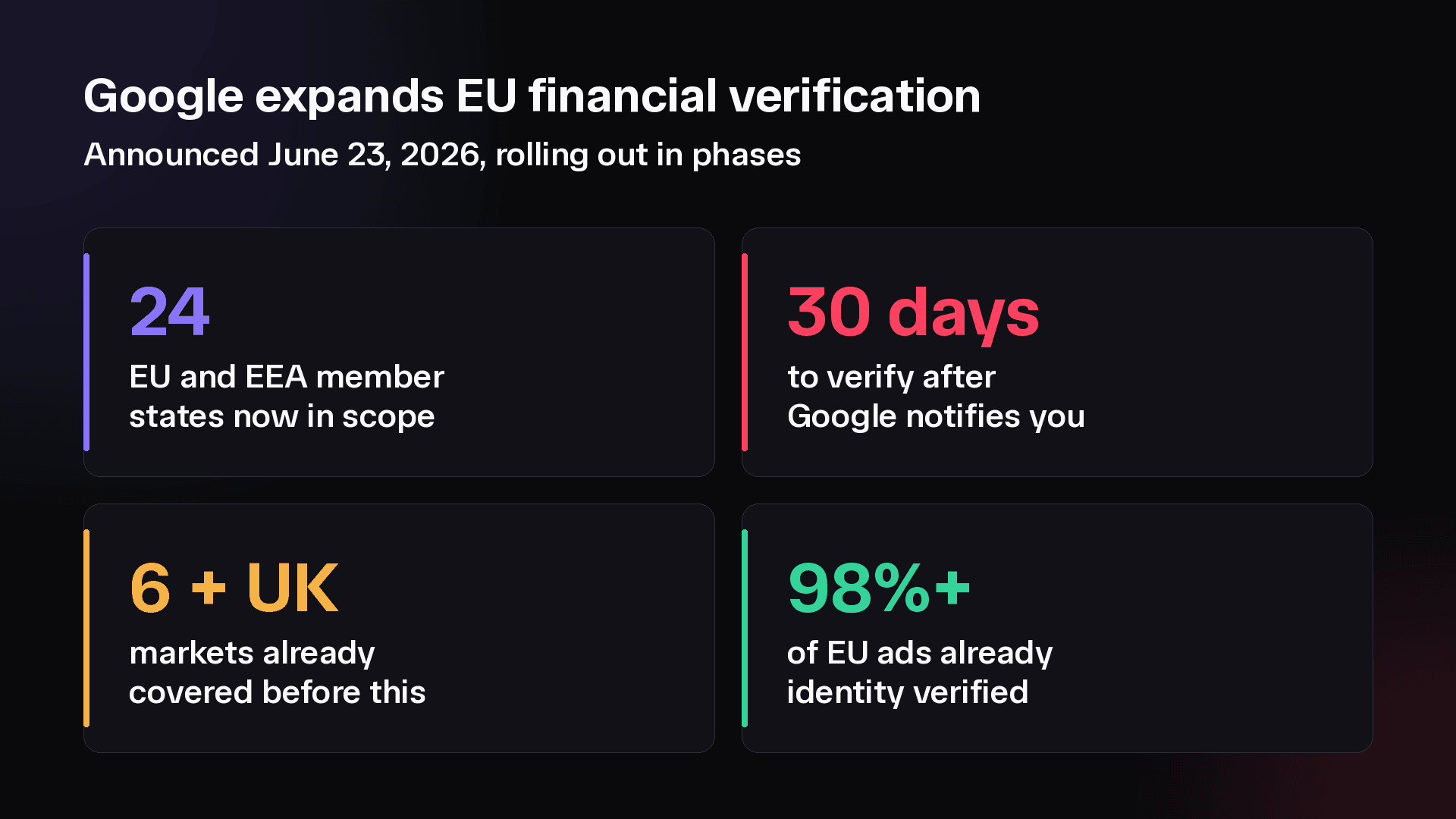
Google announced on June 23, 2026 that it is expanding financial services advertiser verification to all 24 EU/EEA member states. The rollout is happening in phases. Once Google notifies your account, you have 30 days to complete KYC documentation or face ads restrictions. If your company manages multi-market EU campaigns in lending, BNPL, crypto, or insurance, a single missed verification in one country can trigger a broader account review. This is an operational deadline with real consequences.
Key takeaways
- Google announced June 23, 2026 that verification is expanding to all 24 EU/EEA states. The rollout is phased; the 30-day clock starts when Google notifies your account.
- Verification documents include KYC (government ID, business license, address proof) plus vertical-specific proof (lending authority registration, BNPL regulatory approval, crypto licensing).
- A single failed verification in one country can trigger a broader account-level review that may restrict ads across multiple markets on that MCC. This is an operational risk to plan for.
- In our experience, baseline approval takes 2-4 weeks. Resubmission after rejection adds 1-2 weeks, which can consume most of your 30-day window.
- If you miss the deadline, ads stop serving. Recovery timelines are longer, typically 4-6 weeks after successful verification.
Verification Is Now a Standing Obligation
Google's expansion to all 24 EU/EEA states builds on existing identity verification infrastructure that already covers 98%+ of ads served across the EU. This June 2026 announcement extends mandatory financial services verification to every market in the EU and EEA, creating a standing obligation for any fintech, lending, or insurance company running European campaigns.
Verification is no longer a compliance gate for a select few jurisdictions. It is a baseline requirement that affects all multi-market European operations. The pattern signals that Google is treating verification as an ongoing compliance checkpoint, not a one-time gate.
The 30-Day Window Starts When Google Notifies You
Google notifies advertisers through the ad account dashboard. The clock starts from notification, not from when your team first sees it. For teams with decision-makers spread across legal, finance, and marketing, this means the notification can get buried in an email thread before the clock is even acknowledged.
The 30-day window is hard. After 30 days, ads serving against financial services policies stop immediately. No gradual phase-out, no warning, no extension request process. The ads pause. Recovery requires resubmission, which adds 2-4 weeks of processing time.
After 30 days, ads serving against financial services policies stop immediately. No gradual phase-out, no warning, no extension request process.
What Gets Submitted and Why It Fails
Verification requires three components: core KYC, proof of business legitimacy, and vertical-specific regulatory proof.
Core KYC is standard across all verticals. Government ID (passport, driver license, national ID), a business license or registration document, and an address proof (utility bill, government correspondence). These documents must be current, legible, and match the account owner name exactly. Mismatches are the most common rejection reason.
Vertical-specific proof is where most rejections happen. Google verifies by checking credentials directly against the relevant official registry in each market where you operate. Each country has different financial authorities and registration requirements, and submitting the wrong document or using credentials from the wrong jurisdiction triggers an automatic rejection.
For example, BNPL platforms need regulatory approval from the financial authority in each country they operate. Cryptocurrency exchanges need AML/KYC registration with the national financial intelligence unit. Consumer lending requires a lending license or proof of regulatory exemption. Insurance verification requires proof of underwriting license or reinsurance partnership.
The most common mistake is submitting credentials from one market and expecting them to satisfy requirements across all 24 states. Google checks the registered business address against the national authority register for each market you claim. If your business is not registered or authorized in a specific country, verification fails for that market.
"The most common mistake is submitting credentials from one market and expecting them to satisfy requirements across all 24 states."
Operational Pattern: Single Account Rejection, Cascade Review
Here is the operational trap we see regularly. If you run campaigns across 8 EU markets on a single MCC and verification fails in one country, Google can trigger a compliance review of the entire MCC. This is not a market-specific suspension. It can pause ads across all markets under that MCC until the review clears.
The review can take 2-3 weeks. During that window, approved financial services campaigns on that MCC may be paused, even if those campaigns' country-level verification passed. The review is at the MCC level.
Large teams segment by country into separate MCCs specifically to contain this risk. If France verification fails, only campaigns on the France MCC pause. Other markets stay live. If you are on a single MCC for cost efficiency or legacy reasons, a single rejection in any one market can freeze your entire EU operation.
Timeline Math on Resubmission
In our experience, baseline approval takes 2-4 weeks from submission. If your first submission gets rejected (missing documents, address mismatch, wrong regulatory proof for the jurisdiction), resubmission adds another 1-2 weeks to the queue. This puts your resubmission attempt 3-5 weeks into the original 30-day window.
If the second submission is rejected, you have less than 3 weeks left to fix and resubmit again. This is cutting it close to the approval window itself. Most teams do not catch a rejection on day 5 of the cycle, leaving only 25 days to diagnose and fix a problem that takes 2-3 weeks to resolve.
The operational work is heavy. Verification is not automated. It requires legal review of your regulatory standing in each market, signature from an authorized officer, and submission through Google's manual review process. Plan for this work to take 1-2 weeks of internal effort before documents even hit Google's queue.
What Happens When You Miss the Deadline
Ads stop. No notice, no phase-out. Financial services ads serving under Google's restricted category policies go paused. Other ads continue.
Recovery requires submitting verification after the missed deadline, which triggers a different approval timeline. Google treats late submissions as full reapplications, not deadline-extension requests. Processing can take 4-6 weeks instead of the standard 2-4 week window.
For lending companies, a 4-6 week pause is a quarter of monthly revenue gone. For BNPL platforms running seasonal campaigns, missing verification during peak periods is catastrophic.
Need a compliance review before submission?
Oligamy's compliance strategy service audits your KYC readiness, maps vertical-specific requirements by country, and provides pre-submission sign-off to reduce rejection risk.
Schedule a consultationFrequently Asked Questions
For companies running multiple EU markets, verification is now a quarterly operational task, not a one-time gate. Regulatory frameworks change, documents expire, and business registration updates require new submissions. The 30-day window is tight enough that a missed notification can mean a missed deadline. Set a calendar alert for 60 days before your current verification expires, and audit your regulatory standing in each market by month 2 of the cycle.
For deeper context on how financial disapprovals surface in your account and troubleshooting workflows, see our Google Ads financial disapproval patterns guide. For multi-market account structure strategies that contain verification risk, see launching paid media in new regulated regions.
If your team is managing verification across 8+ EU markets and wants an external compliance review before submission, Oligamy's compliance strategy service audits your KYC readiness, maps vertical-specific requirements by country, and provides pre-submission sign-off to reduce rejection risk.
Compliance is not optional. Reach out if your company is running EU campaigns in fintech and needs a compliance partner.

Kuba Strugarek
CEO & Co-founder of Oligamy Marketing, also a CMO for Oligamy Software activities. Built offline conversion tracking that delivered 536% YoY growth in Latin America. Performance Marketing on regulated markets.