Launching Paid Media in New Regulated Regions
Google restricted 273 million financial services ads globally in 2025. Most disapprovals weren't tactical mistakes. They were architectural ones.
Key Takeaways
- 273M financial services ads restricted globally in 2025 (Google Safety Report).
- Multi region PPC requires separate account structures per regulatory archetype. Copying home market campaigns into new regions causes 40-60% budget burn and suspension cascades.
- Four regulatory archetypes demand different account architecture: Prescriptive Disclosure (EU/CCD2), Pre Approval (GCC/Middle East), Self Regulatory plus Consumer Protection (Latin America/Eastern Europe), and Principles Based (UK/APAC).
- A compliance first launch still runs about 12 weeks, but it trades 40-60% budget burn for zero preventable disapprovals.
- Offline conversion tracking (via ConversionUploadService) works across all consent regimes. Recent fintech client saw 84% CPA reduction.
Why Account Architecture, Not Creative, Is the Problem
A company launches PPC in a new regulated region, copies the bid strategy from their home market, translates the creative, and watches the account burn through disapprovals and account level suspensions. This is a structural failure, not a tactical one.
The core issue: compliance isn't a creative problem. Different regulatory regimes require different campaign structures, different conversion definitions, and different data flows. Most agencies treat localization as translation. It's not. It's structural. If two markets have different mandatory disclaimers, they need different ad groups feeding different landing pages with different conversion definitions.
For a forensic breakdown of what specific patterns trigger fintech PPC disapprovals at the ad and account level, see our 273M restricted ads analysis.
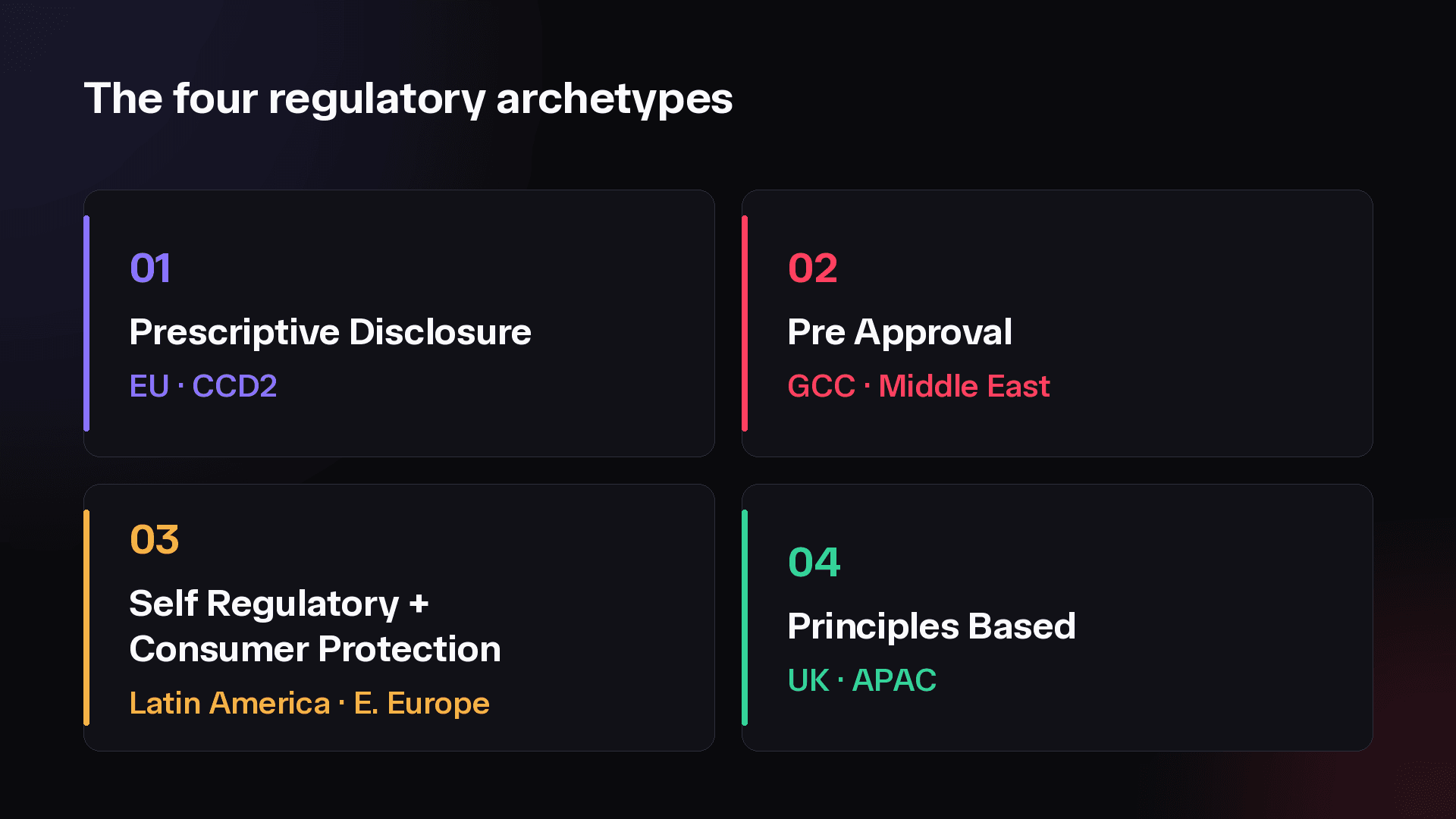
The 4 Regulatory Archetypes
Regulatory frameworks for financial services advertising fall into four categories, each demanding different account structure, creative requirements, and tracking infrastructure. No single account design works across all four.
Prescriptive Disclosure (EU, CCD2)
Regulatory body mandates specific warnings and banned language. Warnings must appear in ad copy or landing page. You cannot suppress or minimize them. Separate campaigns per country required because mandatory disclaimers vary. Stricter creative review before launch. Requires Consent Mode v2 for tracking.
- Region: EU (CCD2)
- Approval required: Platform review, 2-4 weeks
- Disclaimer placement: Mandatory in ad copy or landing page
- Campaign structure: Campaign per country (different disclaimers per market)
- Consent regime: Consent Mode v2 (opt in)
- Consolidation possible: No. Different disclaimers require separate ad groups.
Pre Approval (Select GCC, Middle East)
Requires central bank approval before any ad appears publicly. Approval timelines run 2-8 weeks. Your launch date isn't when you activate the campaign in Google Ads. It's when the regulator approves the creative. Everything else happens before approval. Post approval, you launch into a market with zero real traffic data. Initial bid strategy must be conservative, grounded in home market learnings and adjusted for local economics.
- Region: GCC, Middle East
- Approval required: Central bank approval required, 2-8 weeks
- Disclaimer placement: Varies by market
- Campaign structure: Campaign per market, launch date = regulator approval
- Consent regime: Opt out assumed
- Consolidation possible: No. Approval timelines differ.
Self Regulatory Plus Consumer Protection (Latin America, Eastern Europe)
Combines industry self regulatory codes with federal consumer protection laws. More creative latitude than prescriptive regimes, but less certainty. You exercise judgment. Tighter legal review before launch, but not waiting for regulator approval. Disputes resolve post hoc through consumer protection bodies or arbitration.
- Region: Latin America, Eastern Europe
- Approval required: Legal review, 1-2 weeks
- Disclaimer placement: Context dependent
- Campaign structure: Campaign per country, can vary structure
- Consent regime: Opt out assumed
- Consolidation possible: Partial. Same legal entity can span 2-3 countries with consistent compliance frameworks.
Principles Based (UK, Select APAC)
Provide high level principles ("fair, clear, not misleading") without prescribing exact language. You have creative freedom. You're responsible for principle interpretation. Enforcement is post hoc. You can consolidate campaigns across multiple markets under one principles based framework, but you need stronger internal compliance infrastructure.
- Region: UK, APAC
- Approval required: Post launch enforcement only
- Disclaimer placement: Interpretive, case by case
- Campaign structure: Multi country consolidation possible
- Consent regime: Opt out assumed
- Consolidation possible: Yes. Single campaign framework can span UK, AU, NZ, SG if internal compliance review is rigorous.
The structural problem? You can't fix regulatory differences at the creative layer. If two markets have different mandatory disclaimers, they need different ad groups feeding different landing pages with different conversion definitions. This isn't translation. It's architecture.
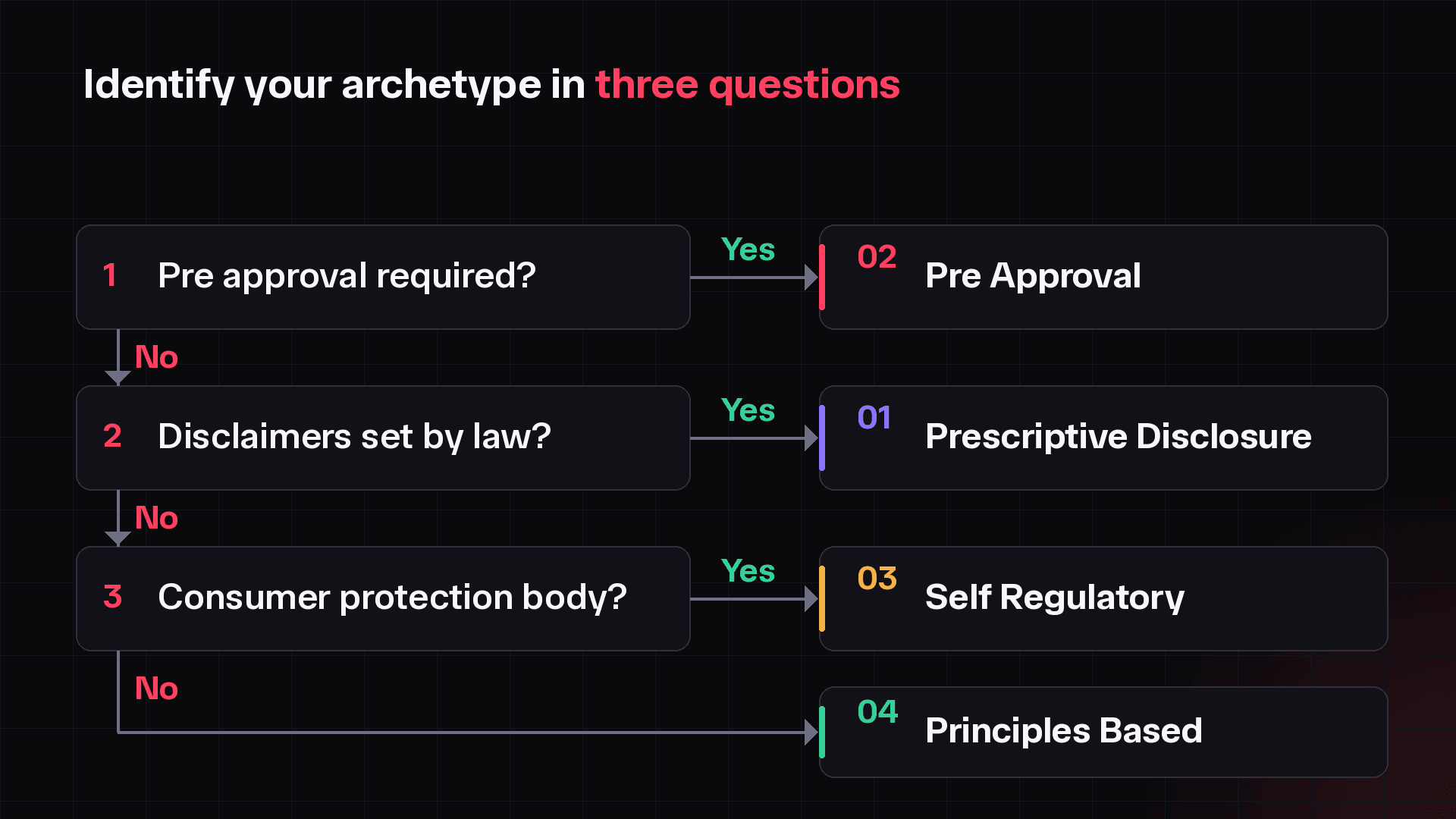
Three Critical Structural Decisions
Billing Accounts: One Per Region or Consolidated?
One account per region requires separate billing entities in most regulated markets. A lender operating across three regulated markets in Europe and Latin America must have local entities in each, even if operationally identical. Separate accounts make consolidated reporting harder, but they isolate suspension blast radius.
Decision rule: if regulatory presence requires separate legal entities, use separate accounts. Entity suspension in one market won't cascade to others. Consolidated accounts work only when all target markets share one legal entity and regulatory reporting cadence.
Campaign Structure: Market by Market or Language Per Campaign?
Campaign per country: each has its own budget, conversion definitions, bidding strategy. If one market faces disapprovals, others aren't affected. You lose algorithm learning across regions due to fragmented volume.
Language per campaign: faster learning across larger volume, but regulatory inconsistency. A single campaign spanning France and Spain with language targeting bypasses the fact that mandatory disclaimers differ by country.
Decision rule: if two markets have different mandatory disclaimers, conversion definitions, or legal entities, they need separate campaigns. One language per campaign structure backfires in regulated industries.
Attribution Across Consent Regimes: The Tracking Asymmetry
Europe requires explicit opt in for non essential cookies (GDPR). GA4 receives conversion data only from consented users. Consent Mode v2 handles estimation for non consented users, but estimates are modeled, not observed. Outside Europe, consent is often assumed unless the user opts out. Your measurement baseline differs by region.
Offline conversion tracking solves the consent asymmetry. You track the real revenue event (funded loan, policy issued) in your CRM, then push that to Google Ads via ConversionUploadService. The algorithm optimizes on real revenue, not estimated conversions. This infrastructure enabled 84% CPA reduction in our most recent fintech engagement. Implementation runs 2-3 weeks.
For the in house vs agency breakeven analysis and 2026 strategic implications, see our Google Ads Safety Report 2026 strategy guide.
First 90 Days: The Compliance First Playbook
A compliance first launch takes 90 days from regulatory mapping to scaled operation. This is 4-8 weeks longer than typical single market launches. It prevents the 40-60% budget burn that poorly architected launches suffer. The timeline is longer, but the math is clear: one agency's 8 week launch with 2x budget burn is not faster. It's just noisier.
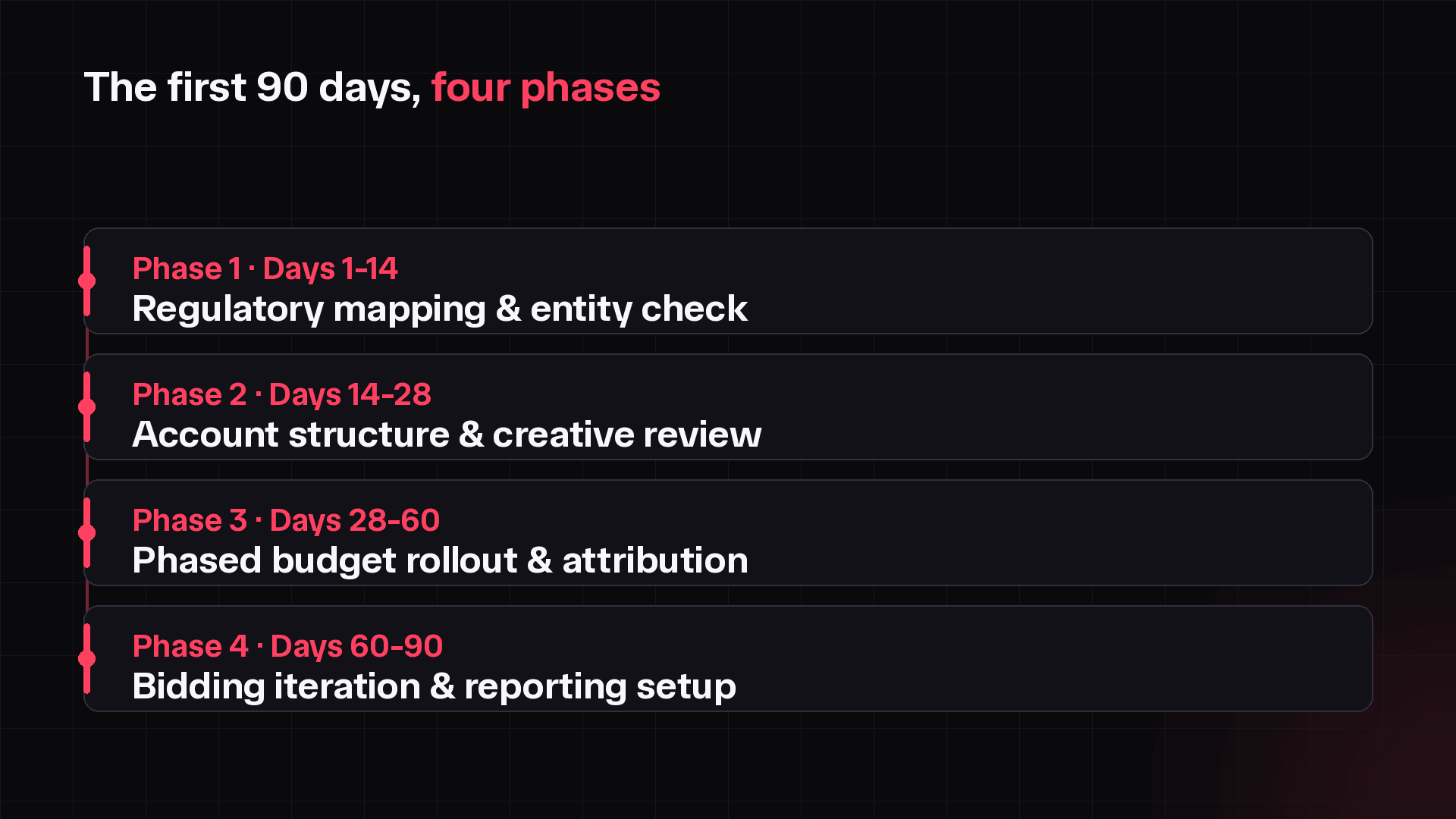
Days 1-14: Regulatory Mapping and Entity Verification
Identify the regulatory archetype. Assign one person to research: primary regulator, mandatory disclaimers, banned claims, approval timeline, post close reporting. Document in a spreadsheet. Verify legal entity status. Can you operate with your current entity, or do you need a subsidiary? Submit the financial services business form to Google Ads. This determines account structure and prevents disapprovals later due to unverified company status.
Days 14-28: Account Structure and Creative Compliance Review
Build account structure per archetype. Write all creatives with the compliance framework baked in, against the Google Ads financial products and services policy. Creative team writes. Legal reviews. Rewrite with requested changes. Submit creatives to platform and legal for approval simultaneously. Budget 1-4 week timelines for platform review.
Days 28-60: Phased Budget Rollout and Attribution Validation
As creatives get approved, launch at 10% of target daily budget. Watch for disapprovals, disapproval rate, click volume, and cost trends. If no additional disapprovals and performance is within expected range, bump to 30% at week 6. Validate offline conversion tracking end to end: CRM event triggers, conversion uploads to Google Ads, appear in conversion report within 24 hours.
Days 60-90: Bidding Strategy Iteration and Reporting Setup
If using value based bidding on offline conversions, switch to target ROAS. Seed with conservative target (3:1 for lending, 5:1 for SaaS) based on home market adjusted for local economics. Set up regional reporting. If separate GA4 properties per region, build a consolidated dashboard showing regional ROAS adjusted for consent regime differences. Analyze performance: CPA trend, conversion rate, ROAS. If stable, plan for scale.
Why This Timeline Matters
Most agencies fail by treating localization as translation. They copy campaigns, translate copy, adjust max CPCs for local economics. By week twelve, the account is either suspended or operating at 40-60% of intended reach. Compliance becomes an afterthought, not architecture.
Expanding paid media into a regulated region isn't about better creative or sharper bidding. It's about recognizing that different regulatory frameworks demand different structural decisions. Identify the archetype. Map the requirements. Let compliance drive account structure. Then fit creative and bidding into the structure that works.
Frequently Asked Questions
Related reading

Kuba Strugarek
CEO & Co-founder of Oligamy Marketing, also a CMO for Oligamy Software activities. Built offline conversion tracking that delivered 536% YoY growth in Latin America. Performance Marketing on regulated markets.