AI Search as Primary Vendor Discovery for B2B Fintech: Your 2026 Content Strategy Needs to Change
51% of B2B software buyers now begin vendor research inside ChatGPT or Perplexity instead of Google Search. For fintech, adoption is steeper because the research questions are inherently technical: API specifications, compliance frameworks, integration workflows. Your high-intent pipeline is now researching your competitors in an environment where you cannot control which sources get cited.
Google SEO still drives discovery. AI search now drives intent-qualified research. Fintech companies still chasing Google rankings are losing vendor discovery traffic to competitors optimized for AI search citation mechanics.
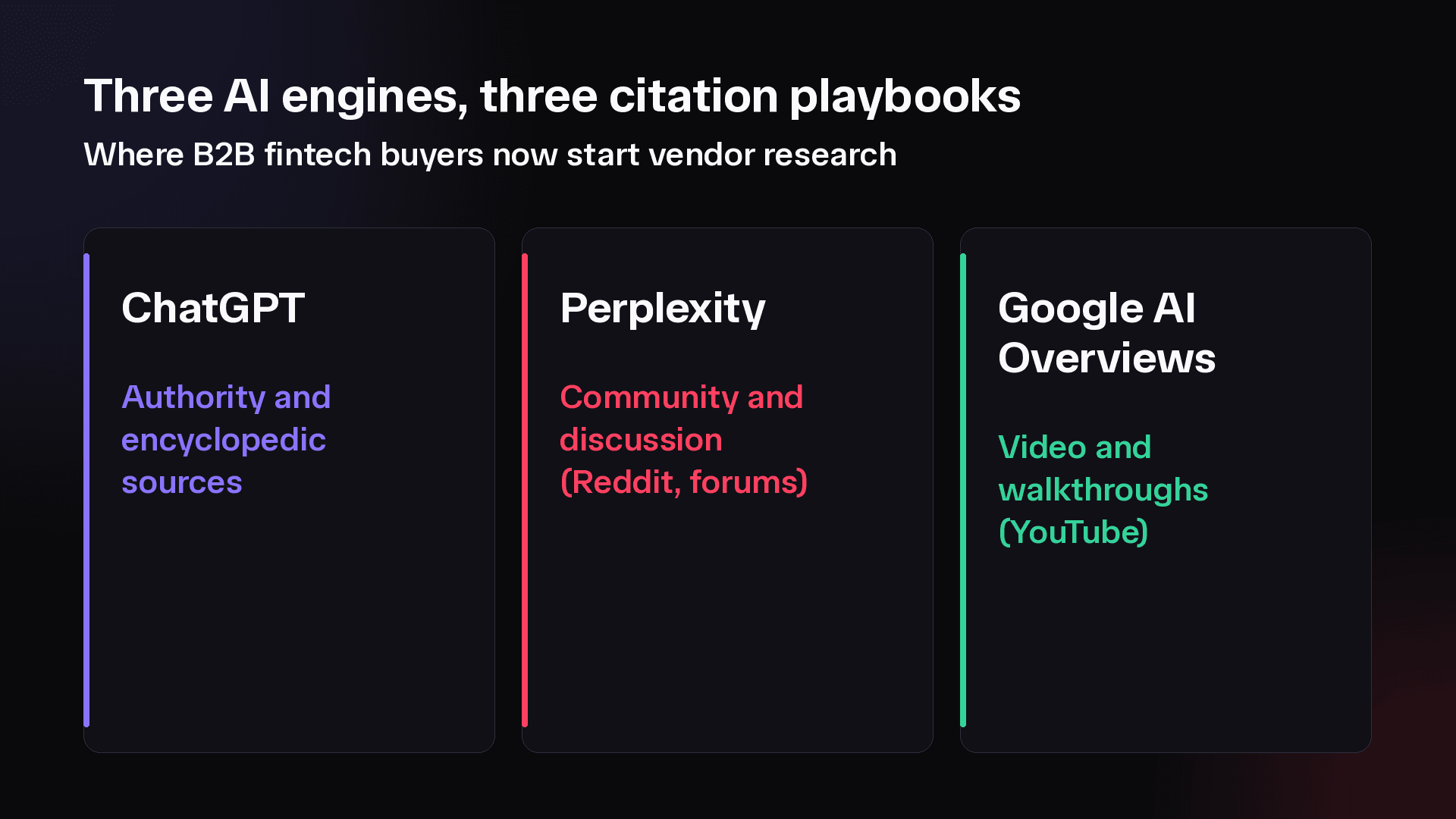
Citation strategies differ fundamentally across ChatGPT, Perplexity, and Google AI Overviews. You cannot write once and win all three. That's the problem your 2026 strategy must address.
Key takeaways
- 51% of B2B software buyers now research vendors in ChatGPT or Perplexity. For fintech, adoption is steeper due to API, compliance, and integration research workflows.
- Citation ecosystems between ChatGPT and Perplexity are almost entirely separate. Three separate content playbooks are required.
- ChatGPT prioritizes encyclopedic authority sources like Wikipedia and official documentation. Fintech content should emphasize regulatory frameworks and definition authority.
- Perplexity heavily weights community discussion and sources like Reddit. Problem-solving and methodology content distributed to fintech communities performs well.
- Google AI Overviews prioritize video and visual walkthroughs. Fintech companies should pair written frameworks with YouTube demonstrations and integration demos.
- AI search platforms cite self-published content on vendor websites at high rates, more than backlinks or press mentions alone. Self-published content drives citations more than external PR.
- AI search traffic converts at 14.2% compared to Google organic's 2.8%. Lower volume, higher intent. Fintech buyers researching specific compliance or integration questions in AI search have already narrowed scope. CAC efficiency is higher than traditional SEO.
Why Fintech Buyers Now Start With AI Search
Five years ago, fintech buying cycles meant a Google search for "embedded lending API" or "API integration compliance" pointed to blog posts and comparison frameworks. Buyers read three articles, called sales. Simple funnel.
Today the entry point is ChatGPT. A prospective customer asks "what are the differences between embedded lending and point-of-sale lending" or "which APIs handle PSD2 compliance". ChatGPT returns a framework, three vendor examples, and links to documentation. The buyer never goes to Google. If your domain is not cited, your company is not in that initial research set.
This is not marginal. 73% of B2B buyers use AI tools like ChatGPT and Perplexity in their research. For fintech, adoption is steeper: the research questions demand synthesis (API specs, compliance frameworks, integration timelines, regulatory pathways). ChatGPT synthesizes regulatory docs and technical standards better than Google's keyword-matched articles.
If your fintech company is not optimized for AI search citation, you're ceding research traffic. The shift is not optional.
Three Platforms, Three Separate Citation Systems
AI search platforms do not share citation sources. Only 11% overlap between ChatGPT and Perplexity. The citation systems are almost entirely separate.
ChatGPT prioritizes encyclopedia-grade authority. ChatGPT's training heavily weights established authority sources like Wikipedia, official documentation, and regulatory sources. If your fintech company publishes a blog article on "APR calculation methodology under CCD2", ChatGPT will cite it only if the article reads like an authoritative definition, not a marketing pitch. The content should be regulatory definition first, your company's implementation second.
Perplexity weights community discussion and sources. Perplexity emphasizes current discussion and community consensus, favoring Reddit, Hacker News, and specialist forums over brand authority. To get cited by Perplexity, distribute content to fintech communities where practitioners solve problems. A technical deep dive on "handling rate limiting in lending APIs" posted to r/fintech will get cited. The same article on your corporate blog will not.
Google AI Overviews prioritize video. Written frameworks still rank, but video demonstrations rank higher. For fintech, compliance walkthrough videos, integration tutorials, and live API demos get cited more than documentation alone. Google AI Overviews cite YouTube videos for "how-to" questions and written frameworks for "what is" and "define" questions.
One article doesn't win all three platforms. ChatGPT requires encyclopedic authority. Perplexity requires community distribution and problem-solving. Google AI Overviews require video and interactive content. Three separate content playbooks for one buyer journey.
"Citation strategies differ fundamentally across ChatGPT, Perplexity, and Google AI Overviews. You cannot write once and win all three."
Self-Published Content Wins Citations in AI Search
AI search platforms cite vendor websites directly more than backlinks, aggregators, or press mentions. This differs from Google organic, where external links carry weight. In AI search, your own published content is the primary asset.
Specifically for fintech:
- Regulatory frameworks on your site get cited. Publish "CCD2 compliance checklist" on your domain. ChatGPT cites it directly. A third-party comparison including your checklist does not get cited.
- API documentation drives citations. Perplexity cites your integration docs when developers ask "how do I implement OAuth2 for lending verification".
- Concrete case studies beat abstract claims. "How a European lending platform cut verification from 48 to 2 hours using our API" gets cited. "We help fintech move faster" does not.
Build AI search strategy by publishing authoritative content on your domain first. Backlinks matter for Google. For AI search, your own pages are primary.
ChatGPT Citation Strategy for Fintech: Authority and Regulatory Frameworks
ChatGPT's citation preference for encyclopedic authority means your fintech content should read like a regulatory definition first and a product pitch second.
Content that gets cited by ChatGPT for fintech buyer research:
- Regulatory frameworks owned by your point of view. Example: "The four regulatory pathways for consumer lending approval under CCD2 and which one your fintech qualifies for" (definition + framework, then your company's approach). ChatGPT cites this when answering "what are my options for CCD2 compliance".
- Technical definitions with concrete examples. Example: "What is underwriting velocity, why it matters, and how lenders measure it" with your company's framework. The definition matters more than your implementation.
- Compliance requirement summaries by country or regime. Example: "PSD2 SCA exemption requirements for transaction value, trust list, and recurring payments: the complete breakdown by country" published on your domain. ChatGPT cites this directly when fintech practitioners ask about SCA exemptions.
What doesn't get cited: generic product descriptions, abstract innovation claims, or comparison frameworks that position your company as "best". ChatGPT flags those as marketing.
Write pattern: lead with definition or framework, provide concrete mechanics, then position your approach as one implementation. The article should be useful to fintech practitioners who may never buy from you. That utility is what makes it citable.
Perplexity Citation Strategy for Fintech: Community Distribution and Problem-Solving
Perplexity weights community consensus. Your fintech content gets cited when it solves a problem practitioners are debating in communities.
Content Perplexity cites for fintech vendor research:
- Problem-solving content distributed to communities. Example: "We solved rate limiting in our lending API by implementing adaptive backoff. Here's the algorithm." Posted to r/fintech, Hacker News, fintech Slack. Perplexity cites it when practitioners ask "how do others handle lending API rate limiting".
- Technical methodology frameworks shared in forums. Example: "Our approach to batch processing consumer verification without degrading real-time API latency." Share and discuss in fintech engineering communities. Community discussion boosts citation.
- Lessons from scaling fintech infrastructure. Example: "We migrated lending verification from sync to async without losing audit trails." Specific, authentic content gets cited when practitioners ask "how do other lenders handle async verification".
What doesn't get cited: blog posts buried on corporate websites with no community traction, generic best-practices, or content that repeats what communities already know.
Distribution: write problem-solving content on your domain, then share it in fintech communities. Perplexity cross-references community discussion back to source. Discussion amplifies citations.
Google AI Overviews: Video and Interactive Content
Google AI Overviews cite video, interactive calculators, and walkthroughs. For fintech vendor research, YouTube and live demos rank higher than text-only docs.
Content Google AI Overviews cite for fintech:
- Integration walkthrough videos. 5-10 minute YouTube: "Integrating our lending API: step-by-step walkthrough." Cover authentication, rate limits, error handling, working example. Google cites this when practitioners ask "how do I integrate a lending API".
- Compliance video guides. "CCD2 requirements for consumer lending: what changed, what you need to do, timeline." Animated or live walkthrough. Google cites video for "what is" and "how-to" compliance questions.
- Interactive calculators. "APR calculator for installment lending: how fee structures affect borrower cost." Interactive tools on your domain. Google cites them for "what's the cost" or "how do you calculate" questions.
Documentation-only pages, text-heavy blog posts, and generic how-to articles don't get cited.
Production: pair written frameworks with YouTube videos. API docs with walkthroughs. Compliance guides with animated explanations. Interactive content ranks higher in Google AI Overviews than text alone.
AI search traffic converts at 14.2% versus Google organic's 2.8%. For fintech, a high-intent ChatGPT query converts 5x better than a top-3 Google ranking for a broad keyword.
AI Search Converts 5x Higher Than Google Organic
AI search volume is lower. Conversion rate is 5x higher. For fintech, intent matters more than traffic.
AI search traffic converts at 14.2% versus Google organic's 2.8%. Why: AI search queries are specific. A buyer asking "how do I implement PSD2 compliance" in ChatGPT has narrowed scope. They're solving a specific compliance problem, not comparing platforms. If ChatGPT cites your docs, that buyer is high intent.
Google organic drives broad keywords ("lending API", "compliance software") with mixed intent. High volume, low conversion.
For fintech budget allocation:
- Prioritize AI search citation over generic SEO ranking. One ChatGPT citation that converts at 14% beats a top-3 Google ranking at 2%.
- Citation quality beats content volume. You need 20-30 high-authority pieces cited across ChatGPT, Perplexity, and Google AI Overviews. Not 500 blog posts.
- CAC is lower per lead. AI search drives 5x higher conversion, so cost per acquisition is lower despite lower volume.
Shift content budget from generic SEO ranking to AI search citation. Leads are higher intent.
The Three-Month Timeline to Implement AI Search Content Strategy
Most fintech companies are still optimizing for Google SEO. You have a narrow window to implement AI search content strategy before competitors do.
Month 1: Audit and Plan
- Map your current content against ChatGPT, Perplexity, and Google AI Overviews citation criteria. Which articles get cited today? Which do not?
- Identify 15-20 high-priority regulatory, technical, and compliance frameworks your fintech company owns.
- Draft three separate content playbooks: encyclopedic authority for ChatGPT, community-distributed problem-solving for Perplexity, video and interactive for Google AI Overviews.
Month 2: Publish and Distribute
- Publish 10-15 high-authority articles on your domain following the ChatGPT citation pattern (encyclopedic, definition-first, framework-focused).
- Create and distribute problem-solving content to fintech communities following the Perplexity citation pattern.
- Record and publish 5-10 integration walkthrough and compliance guide videos following the Google AI Overviews citation pattern.
Month 3: Monitor and Amplify
- Monitor ChatGPT, Perplexity, and Google AI Overviews for citations. Which content gets cited? Which does not?
- Amplify content that gets cited. Share in more communities, record follow-up videos, create companion guides.
- Iterate on content strategy based on citation performance, not traffic metrics.
The window is now. By Q4 2026, most fintech companies will have shifted to AI search content strategy. The first-mover advantage goes to companies implementing in Q3 2026.
Frequently Asked Questions
Fintech Content Strategy Audit
Your AI search presence determines vendor discovery in 2026. Let our content strategists audit your ChatGPT, Perplexity, and Google AI Overviews citation performance and design the three-playbook content strategy that converts.
Start Your Audit
Kuba Strugarek
CEO & Co-founder of Oligamy Marketing, also a CMO for Oligamy Software activities. Built offline conversion tracking that delivered 536% YoY growth in Latin America. Performance Marketing on regulated markets.