How 'Guaranteed Leads or Your Money Back' Actually Works
Every other agency now sells the same promise: a fixed number of meetings a month, guaranteed, or your money back. It sounds like the agency is taking the risk off your plate. Read the mechanics and you find the opposite. The guarantee is usually built to protect the agency, not to put real pipeline on your calendar. Here is how the model works, where the catch is hidden, and what an honest version looks like.
Key takeaways
- Most lead guarantees are replacement guarantees, not refunds. You get more meetings booked, not your money back, and the replacements quietly absorb the shortfall.
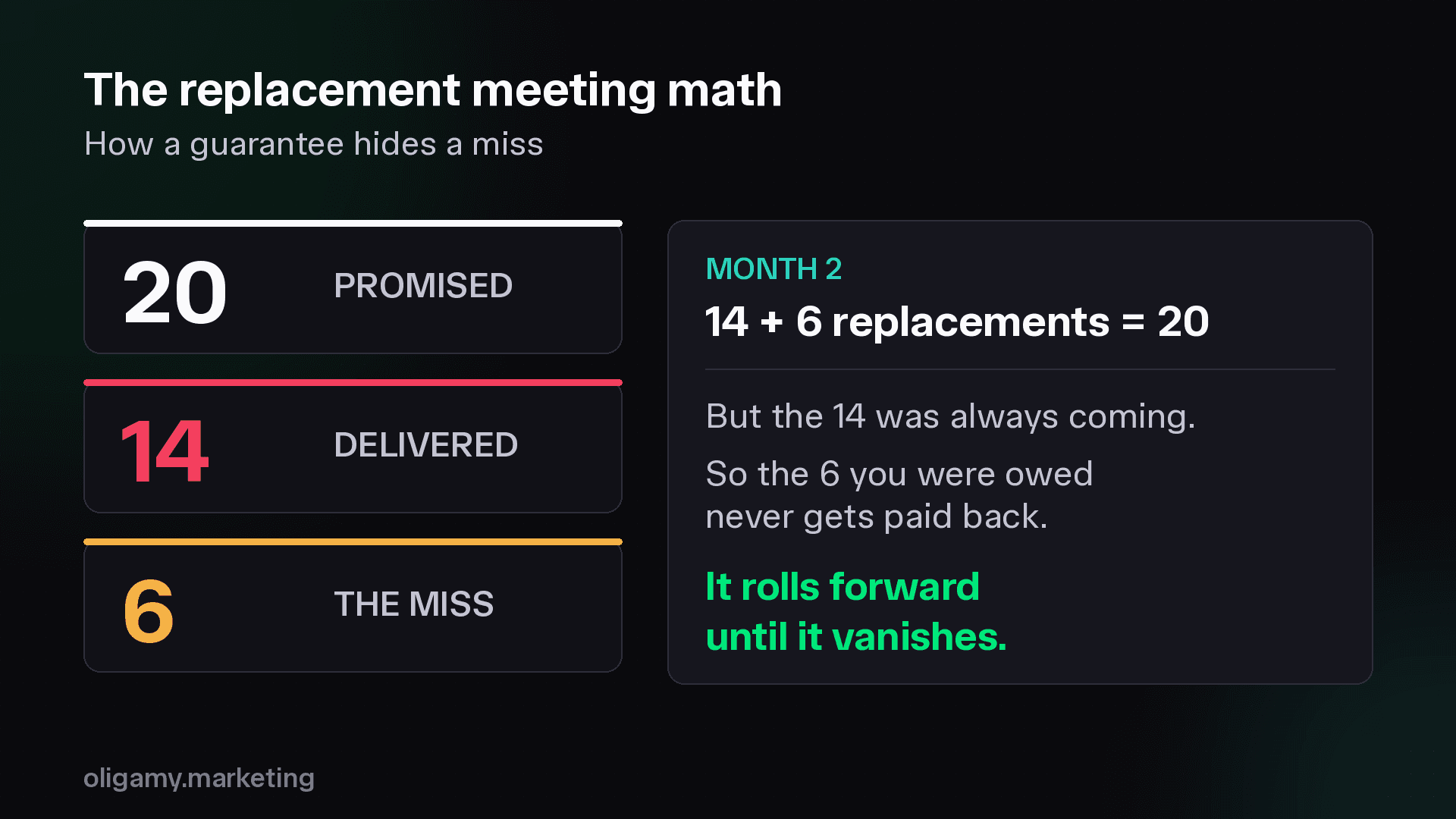
- The replacement math compounds. An agency that promises 20 meetings and delivers 14 covers the gap with next month numbers it was going to hit anyway.
- Volume with no quality bar is the real trap. Hitting a meeting count means nothing if the meetings have no buyer intent behind them.
- Reply rates are a vanity metric. Roughly 1 in 500 cold emails becomes a deal, so a high reply rate with no pipeline is common, not strange.
- A real guarantee ties payment to outcomes you can verify, like accepted meetings or opportunity stage, and moves money when it misses.
The Promise That Sells Itself
A guarantee is a great sales tool because it answers the one question every buyer has: what if this does not work? Put a number on it, add the words "or your money back," and the deal feels safe.
The problem is what the words actually mean in the contract. Most guarantees do not promise revenue, or pipeline, or even qualified conversations. They promise a count of meetings booked. The agency controls how that count is filled, and the contract defines what happens when it falls short. Both of those usually favor the side that wrote them.
The Replacement Math That Hides the Shortfall
Here is the mechanic that does the heavy lifting. Most guarantees are replacement guarantees. If the agency misses the promised number, it books extra meetings the following month to make up the difference. No money moves. You just get more of the same.
Watch what that does over time. An agency promises 20 meetings a month but its real delivery rate is 14. It misses by 6, then promises those 6 as replacements next month. The catch is that next month it was always going to deliver 14 anyway, so 14 plus 6 hits 20 and looks like recovery. The shortfall never gets paid back. It gets rolled forward. By month six the replacements are stretched so thin they are effectively imaginary, and the cumulative gap is invisible in any single invoice.
The shortfall never gets paid back. It gets rolled forward. By month six the "replacements" are stretched so thin they are effectively imaginary, and no single invoice ever shows the gap.
Volume Is Not the Same as Pipeline
The deeper issue is what counts as a delivered meeting. If the guarantee is a number with no quality bar attached, the agency hits it the cheapest way possible: by booking any meeting a person agrees to, regardless of whether that person has a reason to buy.
The numbers explain why this is so easy to hide. In cold outreach, reply rates and deal rates live in different worlds. Roughly 1 in 500 cold emails turns into a deal, while reply rates sit far higher. A campaign can show an 18 percent reply rate and close nothing. So an agency can report strong activity, hit its meeting count, and still send your sales team into a month of conversations with people who were never going to buy. You feel it later, when the pipeline does not move, not in the report.
What a Real Guarantee Looks Like
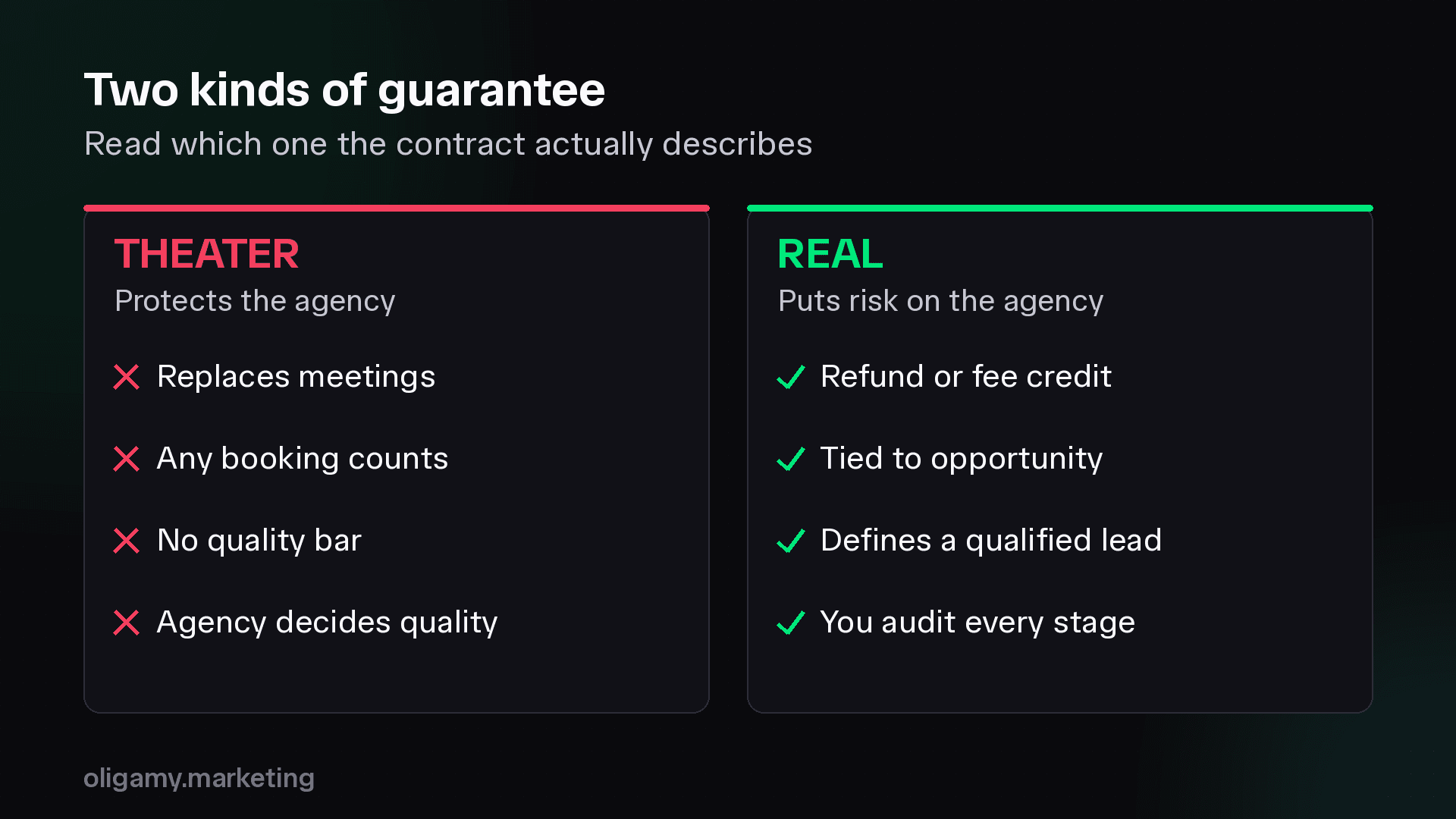
A guarantee is only real when a miss costs the agency something you can collect. That means a refund or a fee credit, not another batch of meetings. Money moving in your direction is the only term that puts the risk where the promise says it is.
It also needs a quality bar. Tie the number to something downstream of the booking, like accepted meetings or opportunity stage conversion, so volume cannot be gamed with low intent calls. Ask two questions before you sign: what exactly counts as a qualifying lead, and who decides. If the answer is vague, or the agency decides alone, the guarantee is decoration.
"A guarantee is only real when a miss costs the agency something you can collect. Money moving in your direction is the only term that puts the risk where the promise says it is."
Where We Stand on This
We do not sell a meeting count with a refund clause buried under it. We run outreach on infrastructure we built and operate, so we can show the part most agencies keep behind a guarantee: what happens after the reply. Our system enriches and targets on real buying signals instead of generic templates, and our dashboard tracks each conversation from meeting to opportunity to closed deal, not just the reply that looks good in a screenshot.
That is the honest version of the same promise. Not a number we can refill with replacements, but a pipeline you can audit at every stage. For how this thinking applies in regulated markets, where the wrong partner costs more than a missed meeting, see our guide to choosing a fintech compliance partner.
See what happens after the reply
We run cold outreach on infrastructure we built, with a dashboard that tracks every conversation from meeting to opportunity to closed deal. No meeting count with a refund clause buried underneath.
See how our outreach worksFrequently Asked Questions
Choosing a lead partner is a contract reading exercise before it is a marketing one. Look for money that moves on a miss, a quality bar you can check, and reporting that follows the conversation all the way to a deal.
Related reading
- How to vet a marketing partner that understands fintech compliance.
- What actually triggers financial services ad disapprovals, across 273M restricted ads.
- The proof case: an 84% CPA reduction and the infrastructure behind it.

Kuba Strugarek
CEO & Co-founder of Oligamy Marketing, also a CMO for Oligamy Software activities. Built offline conversion tracking that delivered 536% YoY growth in Latin America. Performance Marketing on regulated markets.